
Over the past year, almost every software team has introduced AI coding tools into its software development workflow. Yet the results vary wildly. Some teams report dramatic gains in developer productivity, while others quietly admit that their AI assistant produces code they spend just as long reviewing, correcting, and rewriting. The tools are largely the same. The difference lies in engineering discipline.
At Containerverse, we treat AI-assisted development as an engineering problem in its own right — not a feature you switch on, but a system you design.
Two ideas sit at the center of that system: spec-driven development and what we call agent harness engineering. Together, they explain how we’ve turned powerful but unpredictable coding agents into a dependable part of how we build software.
The short version
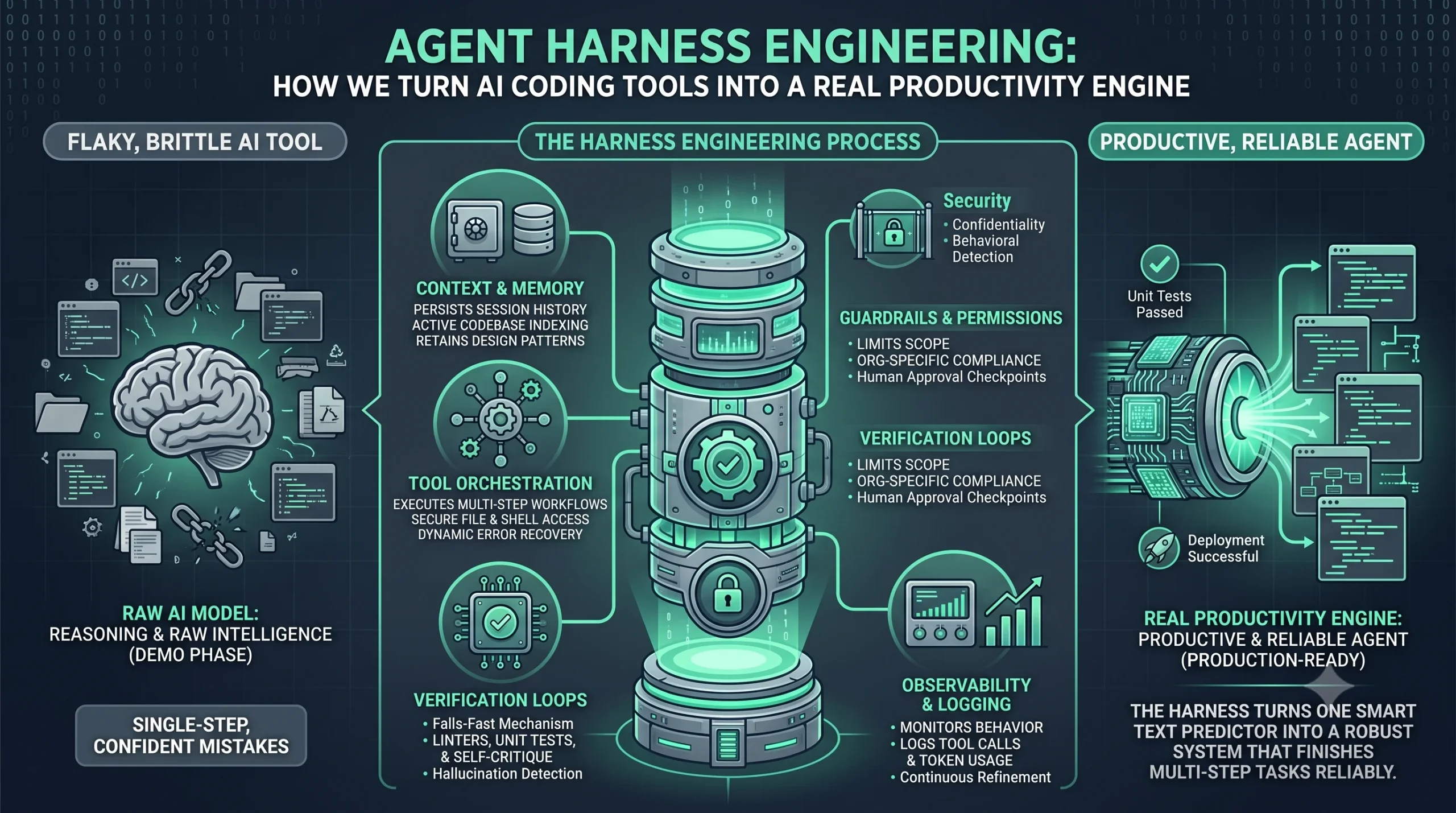
Agent harness engineering is the discipline of building the specifications, guardrails, and verification processes around AI coding tools so their output remains reliable and production-ready. Which AI model you use matters less than many people think. What truly determines whether AI-assisted coding improves software development productivity is the engineering system built around it.
When “Just Add AI” Isn’t Enough
Modern AI coding tools can scaffold services, generate unit tests, refactor modules, and accelerate routine development tasks in minutes. That capability is real.
But raw capability isn’t the same as reliable output. Left unstructured, agents tend to drift — they make reasonable-sounding assumptions, fill gaps with guesses, and produce work that looks finished but doesn’t match what was actually needed.
Here’s what changes when AI enters the workflow: the location of the bottleneck moves. The hard part is no longer typing code. It’s describing intent precisely, steering the agent, and verifying the result.
Teams that don’t account for this shift simply move their effort from writing code to reviewing AI-generated output, reducing the developer productivity gains they expected from AI-assisted software development.
Spec-Driven Development: Making Intent the Source of Truth
Spec-driven development transforms AI software development by replacing vague prompts with structured engineering specifications. Instead of asking an AI assistant to “build a feature,” we define the expected behavior, constraints, interfaces, acceptance criteria, and conditions that determine success before any code is generated.
That specification becomes the single source of truth. The agent works against it, reviewers check against it, and changes are negotiated at the level of the spec rather than buried deep in the code. The payoff shows up fast:
- Output becomes more predictable, because the agent is building toward a fixed target instead of guessing.
- Review gets faster, because there’s a clear standard to measure the work against.
- Intent survives even as code is regenerated or refactored down the line.
Think of it the way you’d onboard a new hire. A good spec does for an AI agent what a solid design brief does for a new team member — it removes ambiguity before the work begins, not after.
The Harness Is What Makes the Model Useful
Here’s the idea we keep coming back to: the model is only a component. What actually turns a capable model into consistent engineering throughput is everything built around it:
- The context it receives
- The guardrails it operates within
- How work gets broken down and handed off
- The checks that validate every output
We call this the agent harness, and engineering it well is where most of the real value gets created.
In practice, the harness becomes the foundation of an effective AI development workflow. It ensures that AI coding tools produce consistent, reviewable, and maintainable software rather than isolated pieces of generated code.
A good harness is, by design, largely tool-agnostic. We use a carefully selected stack of agentic coding tools and open specification frameworks, combined so their strengths reinforce one another. But the specific tools matter far less than the system they sit inside — swap one component for a newer one and the harness still holds, because the discipline (specs, structured handoffs, verification loops) is what does the work.
Think of it like a professional kitchen. A sharper knife helps, but it’s the prep, the process, and the checks before anything goes out that determine whether service runs smoothly. The tool is the knife. The harness is the kitchen.
The model is only a component. The harness is what turns it into reliable engineering throughput.
How We Think About It at Containerverse
At Containerverse, we see AI-assisted coding as an engineering capability rather than a shortcut. Our goal isn’t simply to write code faster, but to build a repeatable software engineering workflow where AI consistently improves quality, delivery speed, and developer productivity. The goal is consistency: a junior engineer and a senior engineer, working through the same harness against the same kind of spec, should both produce work that clears the same bar.
The practical effects appear across every software project we deliver. On well-defined work, AI coding tools handle much of the repetitive implementation while our engineers focus on architecture, security, scalability, and business logic. This balance allows us to improve software development productivity without compromising engineering quality.
On unfamiliar codebases, the same specifications let both our engineers and the AI move faster, because everyone works from the same map instead of a blank page.
There’s a quieter benefit too: because intent lives in specifications rather than in one person’s head, our work is easier to review, hand over, and maintain, even months later, even when a different engineer picks it up.
We’re deliberately not publishing our exact stack or internal playbook — that part is hard-won — but the principles behind it are ones we’re happy to share.
Why It Matters Beyond Our Own Team
The broader lesson applies to any organization adopting AI software development. Competitive advantage no longer comes from simply having access to AI coding tools. It comes from building the engineering discipline, workflows, specifications, and verification processes that enable those tools to produce reliable business software.
As models keep improving, access to “the best model” is becoming close to universal. That means it stops being a real differentiator. The teams that benefit most won’t be the ones with the fanciest model — they’ll be the ones who’ve built the discipline, the specifications, and the harness to use it well.
AI is rapidly becoming a standard part of modern software engineering. As AI coding tools continue to evolve, organizations that invest in structured AI development workflows, clear specifications, and robust engineering processes will achieve lasting improvements in developer productivity and software quality. At Containerverse, that’s the future we’re building toward — transforming AI from a coding assistant into a dependable software engineering capability.
What This Means for Our Clients
Businesses don’t choose a software development partner because they use AI — they choose one because they deliver reliable software. Whether we’re delivering custom software development, SaaS products, or internal automation tools, our approach to AI-assisted coding enables us to accelerate development while maintaining the engineering standards, testing, documentation, and long-term maintainability that enterprise software demands. For our clients, this means faster delivery, greater consistency, and software built for long-term success.
Build Software the Smarter Way
If your team’s AI tools are producing code that takes as long to review as it would have taken to write, the problem usually isn’t the model — it’s the system around it. Containerverse designs AI-assisted development workflows, built on specs and engineered harnesses, that deliver real speed without sacrificing quality.